
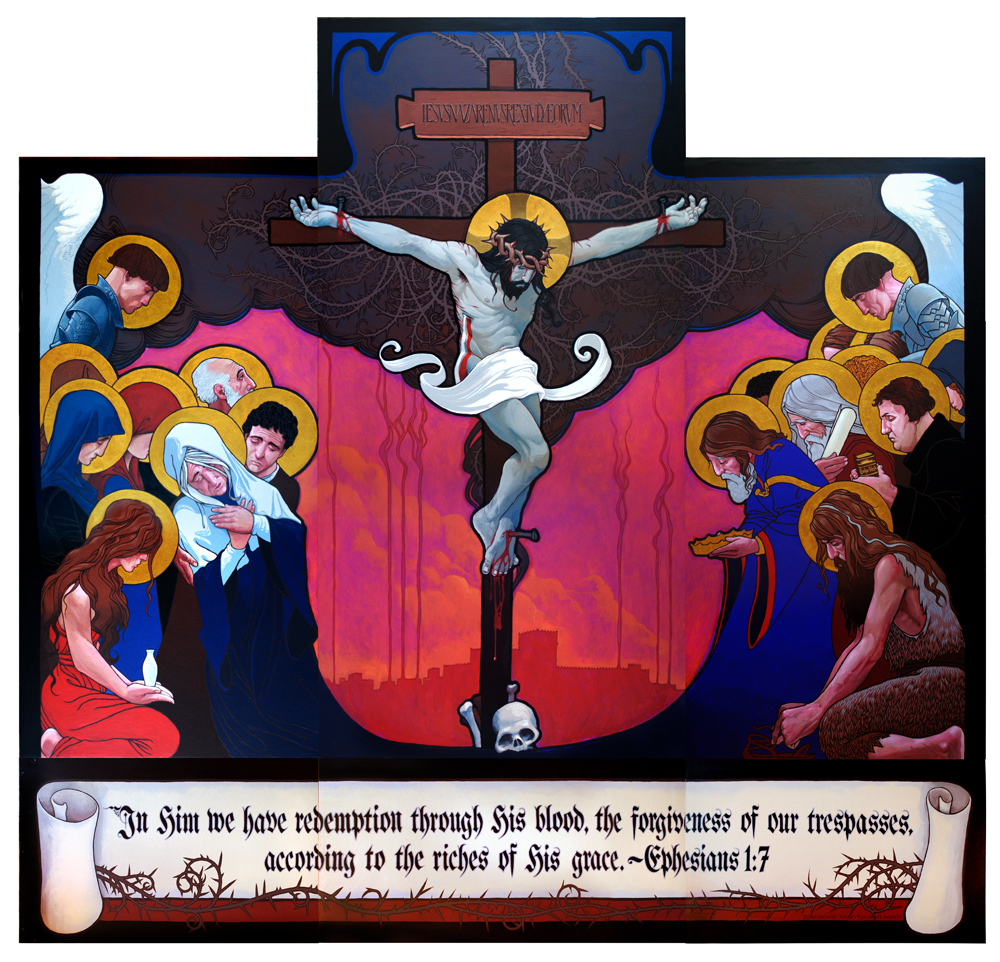

In Him we have redemption through his blood, the forgiveness of our trespasses, according to the riches of his grace.
Ephesians 1:7
When the artist, Edward Riojas, first came to visit our church to talk about a piece of art to adorn our sanctuary we measured walls and spoke about themes. My hope was for the painting to express something about Redemption; the congregation and the concept of the name of our congregation, Redemption. If the congregation had been named Saint “So and So” Lutheran Church it would be easy to find an image; the work and faith of that saint. Redemption, though, as a concept, is more complicated to express.
The name, Redemption, as used in the New Testament, gives us an understanding of freedom. The word we translate to “redemption”, might also be translated to liberation, buying back (as in buying one out of slavery), or as a release from pain or from captivity. This defines us as a congregation. We have been redeemed out of sin, death, and the power of the devil. Our redemption has come to us, the prison walls have fallen, and the chains of death are loosed, because our redeemer has paid for our liberation.
Redemption then is what is depicted in the painting which will fill our north wall. The eye is first drawn to the center of the painting where we find the crucified Jesus. As we learned in our Small Catechism, “(Jesus) redeemed me, a lost and condemned person, purchased and won me from all sins, from death, and from the power of the devil; not with gold or silver, but with his holy, precious blood and with his innocent suffering and death.” (SC Second Article’s explanation) Our liberation has been paid for by the Son of God and son of Mary, Jesus, with his death. Sin has brought us into the camp of Satan. We are bound to him and indebted to him. He owns our life. But the perfect sinless offering of the life of Jesus for our life has redeemed us, given us redemption from sin, death and the devil.
Within the center panel of the painting are also other redemption themes. Behind the cross is an entanglement of thorns. This draws one’s mind to Genesis 22 in which Abraham is called on by God to sacrifice his own son, Isaac. As soon as Abraham lifts the knife to make the sacrifice, an angel of the Lord rebukes him and shows him a ram who is stuck in a thicket. This ram was to be sacrificed instead of the son. God, though, does not spare his own Son, but gave him for our sacrifice for sin. We see in the painting that Jesus is the Lamb entangled for us in the thicket of thorns and he is the one to be sacrificed for our redemption.
Also within the center panel at the foot of the cross is the shadow of the temple. Here the sacrifice of redemption had been made for generation after generation of Israelites. Now the perfect sacrifice for all sins of all time is made on the altar of the cross. As well, at the foot of the cross is a skull and bone. These bones give us many meanings of understanding. It can refer to the name of the hill on which Jesus was sacrificed, Golgotha, the place of the skull. One might understand this portrayal as the defeat of death. It has also been a tradition since the early church (reported by St. Jerome and St. Chrystisom in late 300s AD) that the place of the skull is the burial place of Adam, our first parent. These then might be Adam’s bones. In Adam’s sin all mankind fell. Now in Jesus’ sacrifice all sin is paid for and all mankind has redemption.
We then look to the side panels of the painting. There we find on both side panels a winged angel. This reminds us of the Ark of the Covenant. In Exodus 37 we read that the construction of the Ark includes instruction to form two cherubim of gold spreading out their wings and looking upon the Mercy Seat where the blood of the sacrifice would be poured as an offering for sin. Here as the blood of the Lamb that takes away our sin is offered on the final and perfect altar we see the winged cherubim recalling to our minds all the animals that were sacrificed in anticipation of the coming sacrifice for our redemption.
We see also on the panels the faces of many saints of Scripture as well as Martin Luther. On the left hand panel we see King David taking a humble bow before the cross. David wrote in the Psalms “The lord said to my Lord, sit at my right hand,” (110:1) which Jesus acknowledged in Matthew 22 was about himself who is the son of David and yet his Lord and God. David is at the cross offering his crown reflecting the account in Revelation 4:10 of the elders throwing down their crowns before Jesus on his thrown. We also see the women who were at the cross along with Mary the mother of our Lord and the disciples John and Peter. Additionally, we see Mary the sister of Lazarus and Martha portrayed with tears in her eyes, her long hair exposed, and an alabaster jar of pure nard in her hand. This recalls for us the account of John 12 in which she anoints Jesus for burial by pouring the nard on his feet and whipped them with her hair.
In the right panel we see along with Martin Luther the Old Testament prophet Isaiah whose prophesy described for us (in chapter 53) the man of great sorrow who was stricken, smitten, and afflicted by God and who bore our grief and sorrows. Like a lamb he went to his slaughter without complaint. Because of his death we have redemption. We also see in the right panel John the Baptist, the fore runner of Christ who called all to prepare for the coming Christ.
Finally, at the foot of the cross are the words of Ephesians 1:7, “In Him we have redemption through his blood, the forgiveness of our trespasses, according to the riches of his grace.” A verse which expresses all that we see in the painting adorning our sanctuary. In Christ Jesus’ shedding of his blood we have redemption – liberation from our captor – because our forgiveness has been purchased for us. Not because we deserve this great gift, but because of his grace; God’s good favor toward sinners.
This wonderful addition to our sanctuary came to us because of a gift given by Joyce Graham in memory of her friend Richard Mapes. Thank you, Joyce.
– Pastor Karl Strenge
The Artist, Edward Riojas
Learn more about the artist by going to his resources linked below.